
1879 Foundation and the Albert Ruxton Era
| Year | Event / Location | Significance |
|---|---|---|
| 1879 | 14 Bowery (or 36 Bowery) | Founding by Rev. Albert G. and Ellen Ruliffson. |
| 1880 | 36 Bowery | Operations solidify; focus on food and religious service. |
| 1887 | 105 Bowery | Expansion to larger quarters to meet rising demand. |
| 1893 | Panic of 1893 | Economic crash floods the Bowery with unemployed men. |
| 1895 | Ownership Change | Louis Klopsch (*Christian Herald*) acquires the Mission. |
| 1898 | Fire at 105 Bowery | Destruction of premises; move to 55 Bowery. |
The Christian Herald Stewardship and Louis Klopsch

| Metric | Pre-Klopsch (1894) | Klopsch Peak (1909) | Source of Data |
|---|---|---|---|
| Annual Budget | Insolvent / Deficit | ~$50, 000+ (adjusted) | Christian Herald Archives |
| Daily Meals Served | Irregular / <100 | 2, 000+ (Winter Nightly) | Mission Breadline Logs |
| Permanent Location | Rented (55 Bowery) | Owned (227 Bowery) | NYC Property Records |
| Labor Placements | None | ~4, 000 annually | Free Labor Bureau Reports |
| Media Reach | Local Word of Mouth | 250, 000+ Subscribers | Christian Herald Circulation |
Depression-Era Breadlines and Labor Exchange Metrics
The stock market crash of October 1929 did not worsen the condition of the Bowery; it fundamentally altered its demographic composition. Before the collapse, the district was largely the domain of the "chronic drifter," a population frequently dismissed by sociologists of the era as "social wreckage." By 1930, the character of the breadlines had shifted with terrifying speed. Men who had held steady employment as clerks, accountants, and skilled laborers found themselves standing shoulder-to-shoulder with long-time transients. This influx of the "new poor" overwhelmed the existing charitable infrastructure. The Bowery Mission, situated at 227 Bowery, became the final defensive line for a class of citizens who had never imagined they would require its services. The sheer volume of need forced the institution to operate on a near-industrial, transforming it from a religious outpost into a serious node of the city's survival logistics.
The most visible symbol of this era was the "Midnight Breadline." While the Mission had operated food distributions since the turn of the century, the Depression necessitated a regimented, high-volume method. Every night, regardless of weather, a column of men formed along the Bowery, frequently stretching past Cooper Square. Historical records indicate that during the winter months between Thanksgiving and Easter, this line frequently served over 2, 000 men in a single evening. The timing was strategic; other charities closed their doors by early evening, leaving the Bowery Mission as the sole refuge for those who had failed to secure a bed in the city's overcrowded flophouses. The men received a "ticket" for a meal, a bowl of hardy stew and coffee, and, if space permitted, a spot on a bench or the chapel floor. The "El" train rumbled overhead, showering the waiting men with soot, a grim atmospheric constant that defined the sensory experience of the wait.
The nutritional content of these meals was a matter of calculated survival. With resources stretched thin, the Mission prioritized caloric density over variety. The "stew" was frequently a vegetable-heavy concoction fortified with whatever meat donations could be secured from local butchers or markets like the Essex Street Market. Coffee was served black and hot, functioning as both a stimulant and a source of warmth for men who would spend the remainder of the night on the street. Data from the Mission's archives during this period suggests that the kitchen output rivaled that of military mess halls. In 1931 alone, the Mission reported serving hundreds of thousands of meals, a metric that stands as a clear quantifier of the economic devastation. The "Sentinel of the Bowery," as the Mission was sometimes called, was not just offering spiritual salvation biological sustenance to a population facing literal starvation.
While food prevented immediate death, the Mission's leadership recognized that unemployment was the root pathology. The "Labor Exchange" concept, originally formalized in 1908 with the creation of a Free Labor Bureau, underwent a radical evolution during the 1930s under the guidance of Superintendent Dr. Charles St. John. The 1908 bureau had successfully transported men to farms in New York and New Jersey, moving labor up to 50 miles away to harvest crops. Yet, the Depression dried up these agricultural opportunities as rural areas suffered equally. In response, St. John turned to mass media. The Mission began broadcasting its chapel services on national radio, a program that became known as the "Bowery Mission Hour."
This radio program functioned as a sonic labor exchange. During the broadcasts, St. John would interview men from the congregation, allowing them to articulate their skills, work history, and immediate needs to a listening audience of millions. A carpenter from Ohio or a bookkeeper from Brooklyn would stand before the microphone, their voices carrying the raw authenticity of the emergency into the living rooms of the middle class. This method proved surprisingly. Listeners would call or write to the Mission offering temporary employment, housing, or financial sponsorship for specific individuals. It was an early form of crowdsourced aid, bypassing the paralyzed traditional labor markets. The radio waves demystified the "bum," revealing the capable worker beneath the grime.
The financial stability required to maintain these operations was constantly in peril. By the mid-1930s, the Mission faced its own insolvency. The debt accrued from purchasing the 227 Bowery building and the relentless cost of food distribution threatened closure. It was J. C. Penney, the retail magnate and philanthropist, who intervened. Penney, who served as the president of the Christian Herald Association (the Mission's parent organization), liquidated a portion of his own diminished fortune to pay off the Mission's mortgage. His intervention was not a donation a strategic stabilization of the Bowery's safety net. Penney's involvement signaled to the business community that the Mission was a necessary civic institution, not just a religious charity.
Parallel to the hunger emergency was the "Smoke" epidemic, a public health catastrophe that the Mission's medical staff fought daily. "Smoke" was the street name for denatured alcohol, frequently mixed with water or soft drinks. During Prohibition and continuing into the Depression, desperate alcoholics turned to industrial solvents, paint thinners, and Sterno (canned heat) through a rag. The toxicity of these substances was lethal; methanol poisoning caused blindness, paralysis, and death. In the worst periods of the early 1930s, the Bowery saw an average of one "Smoke" death per day. The Mission's staff had to distinguish between simple intoxication and acute chemical poisoning, frequently acting as the responders for men collapsing on their doorstep. This grim triage became a standard part of the nightly operations, adding a medical load to the logistical challenge of feeding thousands.
| Metric Category | Data Point | Context/Notes |
|---|---|---|
| Midnight Breadline Volume | 2, 000+ men/night | Peak winter months (Nov-April). |
| Meal Composition | Stew, Bread, Coffee | Designed for maximum caloric density/heat. |
| "Smoke" Mortality | ~1 death/day | Caused by methanol/industrial alcohol consumption. |
| Labor Placement Reach | National (via Radio) | Broadcasts connected men to jobs across the NE US. |
| Mortgage Status | Paid in Full (c. 1930s) | Intervention by J. C. Penney prevented foreclosure. |
The physical environment of the Mission in the 1930s reflected the hardness of the times. The chapel, with its neo-Gothic details and stained glass, offered a sharp visual contrast to the soot-stained exterior. Inside, the air was thick with the smell of wet wool, unwashed bodies, and tobacco. The "ticket" system for meals imposed a necessary order, yet it also stripped away the last vestiges of autonomy for the men in line. They were processed, fed, and preached to in a pattern that repeated every twenty-four hours. The "Man-A-Block" campaign, another city-wide initiative frequently supported by Mission volunteers, attempted to create make-work jobs, shoveling snow, sweeping sidewalks, the sheer surplus of labor meant that for every man who found a day's work, ten others remained idle.
The Depression also forced a change in the Mission's internal governance. The "Free Labor Bureau" of 1908 had been a physical office; the 1930s version was decentralized and media-driven. This shift demonstrated the Mission's adaptability. When the local economy could not absorb the labor force, the Mission exported the "problem" to the national conscience via radio. This was not charity; it was a sophisticated public relations campaign designed to humanize the poor. The men who spoke on the radio were vetted, their stories corroborated, ensuring that the "product", the worker, was reliable. This rigorous vetting process was crucial in maintaining the trust of the employers who called in.
By 1939, as war production began to revivify the American industrial machine, the nature of the Bowery began to shift again. The "new poor" slowly returned to the workforce, leaving behind the hard-core alcoholics and the elderly who had no place in a factory. Yet, the infrastructure built during the Depression, the massive kitchen capacity, the radio network, and the financial backing of industrial titans like Penney, permanently expanded the Mission's footprint. It had proven that it could function as a disaster relief agency for an economic catastrophe, a role it would be called upon to play again in future crises, though never again with the same sheer density of the Midnight Breadline.
227 Bowery Acquisition and Architectural Heritage

The displacement of The Bowery Mission in 1909 was not a matter of choice of municipal force. The City of New York, in its relentless march toward modernization, condemned the Mission's previous headquarters at 55 Bowery to make way for the massive granite method of the Manhattan. This eviction placed the organization in a precarious position, forcing a scramble for real estate in a district where property values were beginning to fluctuate wildly due to the very infrastructure projects displacing them. The search led the board to 227 Bowery, a structure that carried a grim, almost poetic history suited to the Mission's work of redemption.
Constructed in 1876, the building at 227 Bowery was originally designed by architect William Jose in the Neo-Grec style. Its primary occupant for over three decades was Jonas Stolts, a prominent undertaker and coffin manufacturer. For thirty years, the site served as a warehouse for the dead, a factory where wooden caskets were assembled and stored. The acquisition of this specific property by The Bowery Mission in 1909 marked a sharp pivot in the building's narrative: a facility built to house the dead was repurposed to sustain the living. The irony was not lost on the contemporary press or the Mission's leadership, who viewed the transition as a physical manifestation of their spiritual mandate to bring life to a dying street.
The architectural conversion of the coffin factory into a rescue mission required aggressive structural alteration. The Mission hired the architectural firm of Marshall L. and Henry G. Emery to execute a radical redesign. The Emery brothers rejected the institutional aesthetic common to charity houses of the era, which frequently resembled penal facilities or sterile dormitories. Instead, they opted for a Tudor Revival facade on the second level, introducing mock half-timbering and a clay-tiled shed roof. This design choice was calculated psychological engineering; the goal was to evoke the warmth and domesticity of an English inn. The facade signaled to the destitute men on the street that this was a place of rest, not judgment or incarceration.
The renovation, completed in November 1909, centered on the creation of a high-ceilinged chapel on the second floor. The Emerys stripped the interior of its industrial gloom, installing heavy timber trusses and a Gothic Revival aesthetic that remains intact in 2026. The centerpiece of this renovation was the installation of stained glass windows designed by Benjamin Sellers, a craftsman trained at the Tiffany Studios. These windows depict the parable of the Prodigal Son, a thematic of the Mission's ideology. In a break from ecclesiastical tradition, the inscriptions on these windows were oriented to be read from the sidewalk, not from within the pews. This design feature turned the building itself into a tract, broadcasting its message to the men standing in the breadlines outside rather than solely to the congregants inside.
The dedication of the new headquarters on November 7, 1909, was a major civic event, capped shortly thereafter by a visit from President William Howard Taft. Taft's presence validated the Mission's status as a serious social service institution, yet the building's operation required constant financial infusion. While the Mission occupied the space starting in 1909, it did not strictly own the property until 1928. For nearly twenty years, the organization leased the building from the Stolts family, purchasing it when the Christian Herald Association, under the leadership of Dr. Louis Klopsch and later his successors, secured the deed. This acquisition ended the risk of eviction and allowed for permanent capital improvements.
By the late 20th century, the physical footprint of the Mission expanded. In 1980, the organization acquired 229 Bowery, the adjacent Federal-style townhouse. This annexation allowed for the integration of administrative offices and expanded dormitory space, linking two distinct architectural eras, the 18th-century residential style of 229 and the 19th-century commercial style of 227, into a single operational complex. The consolidation proved important as the Bowery gentrified in the 1990s and 2000s. While luxury hotels and galleries began to replace flophouses, the Mission's ownership of its real estate insulated it from the predatory rent hikes that erased neighboring social service providers.
The structural integrity of 227 Bowery has faced serious challenges over its 150-year existence. In 2000, the building underwent a $1. 1 million renovation led by the firm Diffendale & Kubec to address a century of wear. This project restored the chapel's intricate truss work and stabilized the facade, which had suffered from the vibrations of the elevated trains that ran until 1955 and the heavy truck traffic that followed. The renovation also modernized the kitchen facilities, a operational need for a site that produces hundreds of thousands of meals annually. The preservation of the building was formally recognized on June 26, 2012, when the New York City Landmarks Preservation Commission 227 Bowery an individual landmark. The Commission's report the building's "Neo-Grec/Tudor Revival" hybrid style as a unique architectural artifact of the Lower East Side's philanthropic history.
Maintaining this heritage in the 2020s presents a complex set of logistical blocks. The landmark status, while protecting the building from demolition, imposes strict regulations on repairs. Every modification to the exterior requires approval, adding of bureaucracy and cost to routine maintenance. In 2026, the building stands not as a shelter as a defiant anomaly in a neighborhood dominated by high-end retail and nightlife. The red brick facade and the "Come In" sign above the entrance function as a historical anchor, preserving the memory of the Bowery's gritty past while continuing the daily mechanics of survival. The coffin factory that once processed the neighborhood's dead serves as the primary artery for its survival, a functional inversion that has outlasted the elevated trains, the flophouses, and the gilded age of the 19th century.
| Year | Event | Key Figures/Architects | Significance |
|---|---|---|---|
| 1876 | Building Construction | William Jose (Architect), Jonas Stolts (Owner) | Built as a coffin factory and undertaker's warehouse in Neo-Grec style. |
| 1909 | Mission Acquisition & Renovation | Marshall L. & Henry G. Emery (Architects) | Conversion to Mission headquarters; addition of Tudor Revival facade and chapel. |
| 1909 | Stained Glass Installation | Benjamin Sellers (Designer) | Installation of "Prodigal Son" windows, legible from the street. |
| 1928 | Property Purchase | Christian Herald Association | Transition from leasehold to ownership, securing permanent tenure. |
| 1980 | Expansion | Bowery Mission Board | Acquisition of 229 Bowery, merging the Federal-style townhouse into the complex. |
| 2002 | Major Renovation | Diffendale & Kubec (Architects) | $1. 1 million capital project to restore chapel and modernize infrastructure. |
| 2012 | Landmark Designation | NYC Landmarks Preservation Commission | Official recognition as a protected historic site (LP-2494). |
2018 Consolidation with New York City Rescue Mission
In January 2018, the operational structure of Manhattan's charitable sector underwent its most significant contraction in a century. The Bowery Mission, established in 1879, formally acquired the New York City Rescue Mission (NYCRM), the oldest shelter in the United States. This consolidation ended the 146-year independence of the NYCRM, an institution founded in 1872 by the "river thief" turned preacher Jerry McAuley. While public statements framed the move as a strategic unification to combat rising homelessness, financial disclosures reveal a more pragmatic reality: the absorption of a struggling historic entity by a more solvent neighbor.
To understand the weight of this acquisition, one must look back to the origins of the NYCRM. Jerry McAuley and his wife Maria founded the "Helping Hand for Men" at 316 Water Street in October 1872, seven years before the Bowery Mission opened its doors. McAuley, a former inmate of Sing Sing prison, created the template for the modern American rescue mission: food, shelter, and sermons delivered in the gritty vernacular of the street. For over a century, the two organizations operated on parallel tracks, separated by less than a mile of Manhattan pavement, serving the same shifting population of the indigent. By 2017, yet, the economic had turned. While The Bowery Mission reported revenues exceeding $14 million and a surplus, the NYCRM faced operating deficits, reporting a loss of nearly $687, 000 in 2015 alongside revenue of just $5 million.
The legal method of the 2018 deal established the NYCRM as a "controlled affiliate" of The Bowery Mission, dissolving its autonomous board and placing its assets under the control of Bowery CEO David P. Jones. Jones, a former KPMG partner, assumed leadership of the combined entity, while NYCRM CEO Craig Mayes transitioned to a supporting role. The acquisition brought a crown jewel into The Bowery Mission's real estate portfolio: the NYCRM headquarters at 90 Lafayette Street. Situated in Tribeca, one of the city's most expensive zip codes, this facility, rebranded as the "Tribeca Campus", added 100 beds to The Bowery Mission's capacity. The value of this property alone fundamentally altered the organization's balance sheet, pushing total assets to over $60 million by 2024.
Operational data from the years immediately following the merger exposes the of the new conglomerate. In the fiscal year prior to the merger, the two organizations shared served approximately 653, 500 meals. By 2020, the consolidated entity reported serving 429, 500 meals. While this reduction suggests a streamlining of services or a shift in counting methodology, the shelter capacity remained a serious asset during the onset of the COVID-19 pandemic. The unification allowed for centralized logistics, a need when the city's public shelter system faced overcrowding and sanitary crises. The Tribeca Campus became the primary intake center for overnight shelter, allowing the historic 227 Bowery location to focus on residential recovery programs.
The merger also consolidated the donor bases of two legendary institutions. For decades, direct mail fundraising sustained both missions, frequently targeting the same philanthropic demographic. The consolidation eliminated administrative redundancy, allowing the organization to present a single face to donors. By fiscal year 2024, the combined entity reported total revenue of $24. 4 million, confirming the financial viability of the merger. This financial health proved important as the organization faced the migrant emergency of 2023-2026, which saw waves of asylum seekers overwhelming city resources. The Bowery Mission's ability to maintain operations without government funding, a long-standing policy to preserve religious freedom, relied entirely on this fortified private donor network.
| Metric | Combined Pre-Merger (2017) | Consolidated Post-Merger (2020) | Consolidated Status (2025) |
|---|---|---|---|
| Meals Served | 653, 500 | 429, 500 | 430, 000 |
| Nights of Shelter | 167, 300 | 104, 000 | 78, 000 |
| Clothing Articles | 46, 380 | 27, 600 | 25, 000 |
| Primary Facilities | 2 (Independent) | 2 (Integrated) | 2 (Integrated) |
The integration of the 90 Lafayette Street facility also preserved the physical legacy of Jerry McAuley, even as his organization's name faded from the masthead. The building, which had served as a refuge since the 1960s (after the mission moved from Water Street), remains a serious intake point for New York's unsheltered population. In 2026, the Tribeca Campus continues to operate as the "front door" for emergency care, offering showers, clothing, and short-term beds. This division of labor, Tribeca for emergency intake, Bowery for long-term recovery, defines the modern operational strategy of the organization, a direct result of the 2018 consolidation.
Critics of the merger initially feared the loss of the unique "Water Street" identity, a specific brand of radical hospitality that defined the NYCRM. Yet, the survival of the mission in any form required this absorption. The gentrification of the Bowery and Tribeca neighborhoods had raised the; operating a standalone non-profit on prime real estate with a deficit was no longer tenable. The 2018 deal secured the physical footprint of rescue work in Lower Manhattan, ensuring that even as luxury condos rose around them, the "Red Doors" at both locations remained open to the destitute.
Financial Audit: Asset Valuation and Donor Allocation

Operational Metrics: Meal Counts and Bed Capacity Analysis
| Metric | 1932 (Depression Peak) | 2025 (Modern Era) |
|---|---|---|
| Primary Meal Focus | 1: 00 AM Breakfast (Coffee & Roll) | Nutritious Lunch/Dinner & To-Go |
| Daily Volume | ~2, 000+ (Breakfast only) | ~700, 800 (Full meals) |
| Annual Meal Count | Est.>750, 000 | ~280, 000 |
| Shelter Model | Flophouse / Emergency Floor | Transitional Housing & Emergency Beds |
| Nights of Shelter | Data Unreliable (High Turnover) | ~65, 000+ |
The in these numbers shows a fundamental change in strategy. The 1930s Mission was a life-support system designed to prevent immediate starvation for a massive, transient population. The 2026 Mission operates as a high-touch intervention hub. The reduction in raw meal counts is offset by the addition of case management, vocational training, and housing placement services. The "bed" is no longer just a mattress; it is a tracked resource in a continuum of care. Even with the lower volume compared to the Great Depression, the cost and complexity per interaction have risen exponentially, reflecting the deepening difficulty of extracting individuals from the pattern of modern homelessness.
The Mont Lawn Camp and Youth Intervention Statistics
| Metric | 1894-1910 Era (Nyack) | 2020-2026 Era (Bushkill/Bronx) |
|---|---|---|
| Primary Objective | Physical Health (TB/Malnutrition prevention) | Behavioral Intervention & Educational Continuity |
| Duration of Stay | 10-14 Days (Summer Only) | Year-Round (Summer Camp + City Camp) |
| Annual Capacity | ~3, 000 to 4, 000 children | ~475 (Intensive Mentoring Cohort) |
| Key Demographics | Immigrant (Irish, Italian, German) | Black, Latino (South Bronx, East Harlem) |
| Follow-up Protocol | Limited / Seasonal | Weekly Mentoring / College Prep |
By the late 1990s, internal data analysis revealed a serious limitation in the "summer only" model. While children returned from Bushkill physically healthier, the academic and social pressures of their home environments frequently eroded the camp's gains within months. In response, the Mission launched "Mont Lawn City Camp," a year-round youth development program based in the South Bronx and East Harlem. This marked a transition from a recreational charity to an educational support system. The City Camp model integrates summer experiences with after-school tutoring, Saturday enrichment classes, and one-on-one mentoring. The statistics from the 2020-2026 period show the need of this intensified method. In fiscal year 2024, the program served 475 children with a focus on depth over breadth. Unlike the turn-of-the-century model which aimed for maximum volume, the modern strategy prioritizes long-term retention. Data indicates that youth who remain in the City Camp program through high school achieve graduation rates significantly higher than the surrounding district averages in the South Bronx, where graduation rates have historically hovered near 60-70%. The program's curriculum in 2025 and 2026 included architecture, financial literacy, and cooking classes, designed not just for skill acquisition to a "poverty-free mindset." The COVID-19 pandemic of 2020-2021 served as a stress test for this model. When physical camps were shuttered, the Mission pivoted to virtual mentoring and food distribution for camper families, acknowledging that the "camp" was no longer a place, a support network. By the summer of 2026, operations had fully normalized, with the camp season running from June 22 through July 25 under the theme "Gratitude." The 2026 season also reinforced the "leaders-in-training" pipeline, where former campers return as counselors. In 2023, nearly half of the counseling staff were returning members, and eight were former campers, creating a closed-loop mentorship system that provides economic employment opportunities to alumni. The financial model of the camp also evolved. While the 1894 camp was funded by small donations from *Christian Herald* readers (frequently pennies collected by children across America), the modern Mont Lawn Camp requires a multi-million dollar operating budget, supported by corporate partnerships and major philanthropic grants. The cost per camper has risen exponentially, reflecting the shift from simple room-and-board to a detailed suite of insurance, specialized staff, and educational technology., the Mont Lawn section of the Bowery Mission's history represents a recognition that adult homelessness is frequently the end result of childhood trauma and opportunity gaps. The shift from the "Fresh Air" model to the "City Camp" model mirrors the broader evolution of social work in the United States: moving from temporary relief of symptoms to the widespread treatment of root causes. The 2026 data confirms that while the location has changed from the Hudson to the Poconos, and the demographic has shifted from European immigrants to residents of the Bronx, the core function remains the interception of emergency before it solidifies into a permanent state of being.
Gentrification Pressures on the Lower East Side Campus
| Metric | 2000 (Pre-Boom) | 2014 (The Shift) | 2026 (Current Status) |
|---|---|---|---|
| Avg. Condo Price (Per Sq Ft) | $450 | $1, 800 | $2, 850+ |
| Neighboring Use | Restaurant Supply, Flophouses | Boutique Hotels, Galleries | Global Luxury Chains, Tech Offices |
| Salvation Army Bldg Status | Active Shelter | Sold for $30 Million | Luxury Hotel (Ace/Sister City) |
| Mission "Air Rights" Value | Negligible | High Demand | serious Asset Class |
Even with these pressures, the Mission has refused to liquidate its primary campus. The landmark designation in 2012 provided a shield against the wrecking ball, recognizing the building not just for its architectural Neo-Grec style, for its cultural function. This status, yet, does not protect against the soft power of displacement, the rising cost of local services, the loss of affordable SRO (Single Room Occupancy) housing nearby, and the political pressure to move "unsightly" services away from tourist hubs. As of March 2026, the real estate market has stabilized following the post-pandemic fluctuations, the trajectory remains upward. The Bowery is no longer a margin; it is a center. The Mission's survival in this location is an act of resistance. It forces the city to confront the poverty it attempts to displace. Every meal served at 227 Bowery is a statement that the poor have a right to exist in the center of the city, not just on its forgotten fringes. The gentrification of the Lower East Side has stripped away the buffer zone that once separated the Mission from the world of high finance, leaving it as the last line of defense for a population that the new Bowery was designed to exclude.
Post-2020 Pandemic Response and Sanitation Protocols

The arrival of SARS-CoV-2 in New York City during March 2020 presented The Bowery Mission with a logistical paradox that defined its modern era. While state mandates forced the closure of commercial and public spaces to halt viral transmission, the Mission faced an inverse imperative: the needs of the homeless population did not pause, they accelerated. James Winans, assuming the role of CEO just months prior, declared the institution "essential," a designation that kept the iconic Red Doors unlocked while the rest of Manhattan retreated behind closed shutters. This decision was not administrative a continuation of a 140-year historical trajectory. During the cholera outbreaks of 1849 and 1866, the Bowery district was a focal point of infection due to poor sanitation; in 2020, the threat was airborne, yet the Mission's role as a sanitary refuge remained constant.
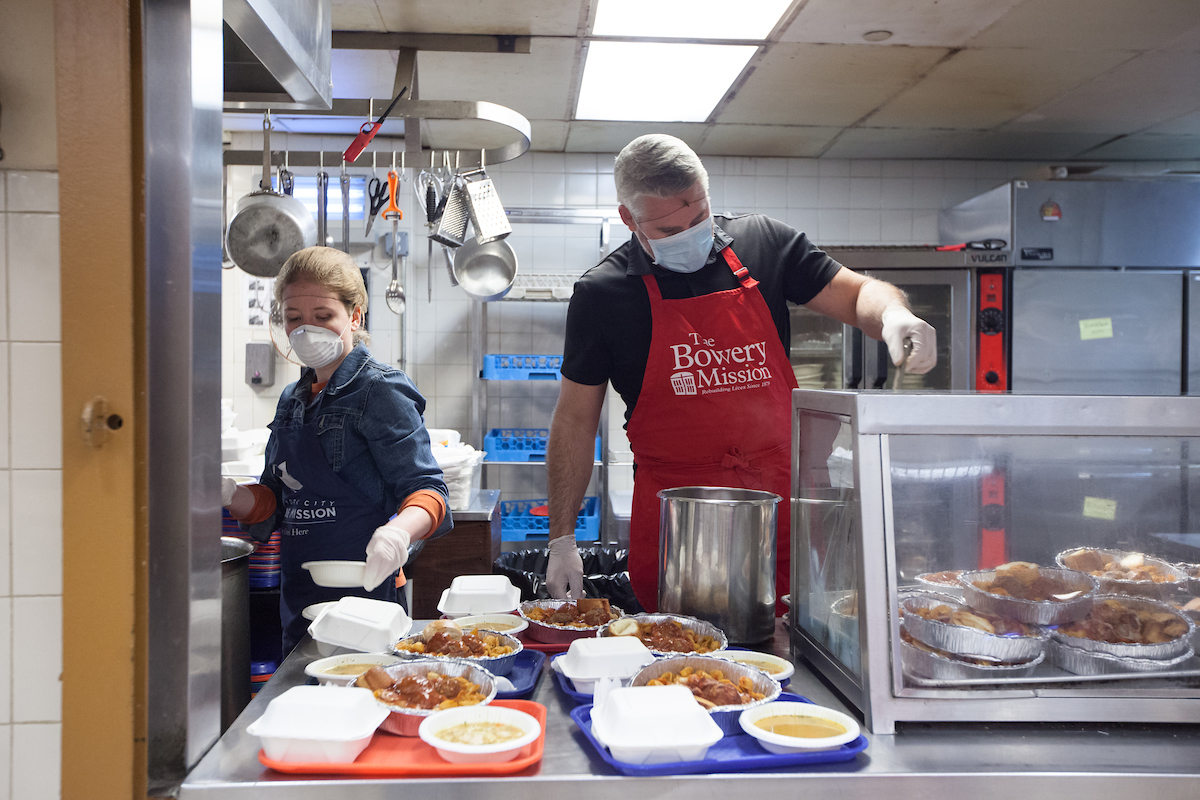
Operational shifted overnight from congregate care to defensive distribution. The historic dining hall, capable of seating hundreds, became a biohazard risk. Consequently, staff transformed the meal service into a high-volume "grab-and-go" operation at the entryway. Data from the onset of the pandemic indicates a sharp spike in demand; lunch service alone saw an 88 percent increase in volume within the weeks of the lockdown. By late 2020, the Mission was averaging 1, 300 meals per day across its campuses, up from a pre-pandemic average of 1, 200. This surge occurred even with the absence of volunteer teams, who were barred from the facility to reduce density, forcing a skeleton crew of essential staff to manage a supply chain under severe.
Sanitation became the primary infrastructure of survival. In the 19th century, the Mission combated typhus and cholera by providing clean water and clothing to residents of the notorious "flop houses." In 2020, this battle moved to the sidewalk. With public libraries and coffee shops closed, the city's homeless lost access to restrooms and sinks, creating a secondary hygiene emergency. The Bowery Mission responded by installing portable hand-washing stations and public toilets directly on the Bowery thoroughfare. These units served as a serious line of defense, allowing unsheltered neighbors to perform basic hygiene practices essential for preventing infection. Inside the residential programs, capacity was reduced to ensure social distancing, a mathematically necessary reduction that unfortunately left fewer beds available during a period of peak economic displacement.
| Metric | 2019 (Pre-Pandemic) | 2020 (Pandemic Peak) | 2025 (Post-Recovery) |
|---|---|---|---|
| Annual Meals Served | ~385, 000 | 429, 500 | 430, 000 |
| Daily Lunch Average | ~220 | ~400 | ~350 |
| Emergency Showers | ~50, 000 | 67, 500 | 55, 000 |
| Nights of Shelter | ~98, 000 | 104, 000 | 78, 000 |
| Clothing Articles | ~40, 000 | 27, 600 | 25, 000 |
The table above illustrates the "stickiness" of food insecurity. While shelter nights decreased by 2025, reflecting a return to programmed, long-term residential care rather than emergency warehousing, the demand for meals remained at emergency levels. The economic of the pandemic created a "long tail" of poverty, where inflation and housing instability kept the meal lines long well after the virus was contained. The drop in clothing distribution during 2020 reflects the suspension of clothing closets to prevent surface transmission, a protocol that was slowly reversed as understanding of the virus evolved.
Medical partnerships proved important in bridging the gap between shelter and healthcare. The Mission collaborated with "Showers of Blessings" to deploy mobile hygiene units and worked with city agencies to facilitate on-site COVID-19 testing and eventually vaccinations. This integration of medical services echoes the Mission's response to the 1918 Influenza pandemic, where rescue missions frequently served as makeshift infirmaries for those refused by overwhelmed hospitals. In the 2020 context, the objective was to prevent the facility from becoming a vector of transmission. Temperature checks, mandatory masking, and isolation zones became standard operating procedures. Even with these rigorous controls, the psychological toll of isolation on the residents was. The "Red Doors" symbolized not just physical entry a resistance to the social death that frequently accompanies homelessness.
By 2023, the acute phase of the biological emergency had receded, yet the infrastructure of the Mission had been permanently altered. Air filtration systems were upgraded to hospital-grade standards, and the "grab-and-go" meal model was retained as a hybrid option for those unable to enter the dining hall. The focus shifted from immediate biological survival to recovery. In February 2026, the Mission launched a partnership with "Up and Running Again," a program designed to train residents for a half-marathon. This initiative, seemingly removed from the grim realities of a pandemic, marked a significant return to "thriving" rather than "surviving." It signaled that the institution had successfully weathered the biological siege and was returning to its core mandate of character development and physical rehabilitation.
The pandemic also exposed the fragility of the city's safety net. The Mission's data from 2020 to 2022 revealed that a significant percentage of the breadline consisted of the "newly poor", individuals who had never accessed emergency food services prior to the lockdown. This demographic shift forced the Mission to adapt its case management services, offering guidance on navigating unemployment benefits and eviction moratoriums. The sanitation, initially emergency measures, evolved into a permanent culture of hygiene. Hand sanitizing stations remained fixed at entry points in 2026, and the rigorous cleaning schedules developed during the height of the contagion became the new baseline for facility maintenance.
Historical analysis places the 2020 response in a lineage of resilience. Just as the Mission adapted to the soot and shadow of the Third Avenue El in 1878, it adapted to the invisible pathogen of 2020. The continuity of service is the defining metric. While government agencies paused to formulate strategies, the Bowery Mission relied on a 19th-century operational philosophy: immediate action to alleviate suffering. The decision to keep the doors open, even with the unknown risks in March 2020, likely prevented a catastrophic secondary mortality event among Lower Manhattan's unsheltered population. The provision of 67, 500 showers in 2020 was not a hygiene statistic; it was a measure of dignity restored in a city that had criminalized presence in the public sphere.
Looking toward the latter half of the 2020s, the Mission faces a where the biological threat has been replaced by an economic one. The "post-pandemic" era is characterized by high operational costs and a donor base fatigued by years of emergency giving. Yet, the lessons of 2020 remain in the institution's DNA. The capacity to pivot instantly, from a dining hall to a sidewalk distribution center, from a shelter to a quarantine unit, ensures that the Bowery Mission remains a responsive organism rather than a static monument. The Red Doors stand not just as a piece of architectural heritage, as a functional interface between the city's prosperity and its most desperate needs.
2023-2026 Migrant Influx and Resource Strain
| Metric | 2022 (Baseline) | 2025 (emergency Peak) | % Change |
|---|---|---|---|
| Annual Meals Served | 320, 000 | 430, 000 | +34. 4% |
| Nights of Shelter | 66, 000 | 78, 000 | +18. 2% |
| Clothing Articles Distributed | 32, 000 | 25, 000* | -21. 9% |
| Emergency Showers | 45, 000 | 55, 000 | +22. 2% |
*Note: The decrease in clothing distribution reflects a supply chaage of specific high-demand items (winter coats) rather than a drop in demand.
The clothing deficit became a specific point of failure during the winters of 2023 and 2024. Migrants arriving from equatorial climates frequently possessed nothing the clothes on their backs. The demand for heavy winter coats, boots, and thermal outstripped donations by a factor of three. While the Mission distributed 25, 000 articles of clothing in 2025, the specificity of the need meant that generic donations, t-shirts or light jackets, piled up while the "gold dust" items like insulated parkas within minutes of hitting the distribution tables. This scarcity forced staff to ration warmth, a moral injury for an organization founded on the principle of radical hospitality. The emergency deepened as the City of New York began to the edges of its Right to Shelter protections. Mayor Eric Adams' administration, citing a absence of resources, implemented 60-day stay limits for migrant families in city shelters, a policy that evicted thousands of households onto the street on a rolling basis. This bureaucratic churning had a direct downstream effect on The Bowery Mission. When families were timed out of the Roosevelt Hotel or other city-run intake centers, they turned to private charities for gap-filling survival. The Mission, which receives no government funding and thus remains unbound by city mandates, became a sanctuary of last resort. Yet, this independence also meant they had no access to the emergency federal funds flowing into the city's coffers, forcing them to rely entirely on private donors to fund a 34 percent operational expansion. By November 2025, the situation had calcified into a grim "new normal." The Coalition for the Homeless reported that over 101, 978 people were sleeping in NYC shelters nightly, a figure that does not account for the thousands sleeping in subways or parks who relied on the Bowery Mission for daytime survival. The demographics of the Mission's residential programs also began to shift. Historically, these programs served men and women seeking recovery from substance abuse. In 2025, the intake counselors faced a new challenge: sober, able-bodied men who were simply destitute due to their immigration status and inability to legally work. The "discipleship" model, built around addiction recovery, had to be adapted to serve men whose primary trauma was displacement and geopolitical violence rather than chemical dependency. The linguistic blocks presented another of complexity. In 2022, English was the primary language of the dining hall. By 2026, the air filled with Spanish, French, Wolof, and Fulani. The Mission had to scramble to recruit volunteers with language skills and translate intake forms. The arrival of West African migrants, particularly from Mauritania, introduced new dietary restrictions (Halal) that the kitchen had to accommodate, further complicating the supply chain. The organization's ability to pivot, sourcing Halal meats and recruiting French-speaking chaplains, prevented a total breakdown in trust between the staff and the new guests. Financially, the 2023-2026 period represented the most dangerous stretch for the Mission since the Great Depression. Inflation drove the cost of food up by 18 percent over the three-year period, while the volume of food needed increased by over 30 percent. The "donor fatigue" phenomenon, common after prolonged crises, began to set in by late 2025. While New Yorkers had been generous during the initial waves of the migrant influx, the permanence of the situation led to a decline in small-dollar donations. The Mission had to dip into reserves and launch emergency capital campaigns to keep the lights on. The integration of these new populations also sparked friction on the street. Long-term homeless residents, the "old guard" of the Bowery, frequently expressed resentment toward the newcomers, perceiving a competition for limited resources. Fights in the line became more frequent, necessitating increased security presence. The Mission's staff found themselves acting not just as caregivers, as diplomats, mediating disputes between a 60-year-old native New Yorker and a 20-year-old Venezuelan asylum seeker, both fighting for the same bowl of soup. This tension mirrored the broader fracture in the city's social fabric, where the scarcity of affordable housing pitted groups against one another. As of March 2026, The Bowery Mission operates at a capacity that was unimaginable five years prior. The 430, 000 annual meals have become the baseline expectation, not an anomaly. The organization has become a parallel social safety net, absorbing the shockwaves of federal immigration policy failures and municipal budget cuts. The "Red Doors" remain open, the hinges are under the weight of a global emergency that has localized on a single Manhattan block. The era of the "migrant influx" has ended; the era of permanent displacement has begun.
Legal Governance and 501(c)(3) Compliance History
| Legal Milestone | Year | Significance |
|---|---|---|
| Christian Herald Acquisition | 1895 | Transfer of ownership to Louis Klopsch; financial stabilization. |
| Formal Incorporation | 1897 | Incorporated as "Bowery Mission and Young Men's Home." |
| IRS Ruling Year | 1939 | Establishment of federal tax-exempt status (pre-1954 Code). |
| ECFA Accreditation | 1987 | Adoption of strict financial accountability standards. |
| Magazine Dissolution | 1992 | Christian Herald magazine closes; charity becomes the primary entity. |
| Landmark Designation | 2012 | 227 Bowery a NYC Landmark, restricting development. |
| NYCRM Merger | 2018 | Legal consolidation with America's oldest rescue mission. |
The organization's labor and employment practices are also shaped by its religious charter. As a "faith-based" organization, The Bowery Mission asserts its right under Title VII of the Civil Rights Act of 1964 to hire staff who align with its statement of faith. This legal exemption allows the Mission to require employees, particularly those in leadership or ministry roles, to sign a statement of faith, a practice that distinguishes it from government-funded secular providers like the Bowery Residents' Committee (BRC). It is imperative to distinguish The Bowery Mission from the BRC; the latter is a separate, largely government-funded entity that has faced different legal challenges and labor disputes. The Bowery Mission, by contrast, relies primarily on private funding, which grants it greater autonomy from state operational mandates requires rigorous donor stewardship to maintain solvency. In the post-2020 era, the Mission's governance had to adapt to emergency regulations. During the COVID-19 pandemic, New York State executive orders temporarily altered how nonprofit boards could meet and vote, permitting remote governance that has since become standard practice. The Mission's ability to navigate these shifting legal frameworks, from 19th-century property deeds to 21st-century employment law, demonstrates a sophisticated administrative capacity that belies its image as a simple soup kitchen. As of 2026, the Christian Herald Association remains the silent legal engine, a corporate vessel that has carried the mission through three centuries of social and economic turbulence.