
Site Selection and 1792 Design Competition Metrics
The physical location of the White House exists because of a backroom political trade known as the Compromise of 1790. Secretary of the Treasury Alexander Hamilton sought federal assumption of state war debts, a measure opposed by Southern states. Thomas Jefferson and James Madison agreed to support Hamilton's financial plan in exchange for placing the permanent national capital along the Potomac River. The Residence Act, signed by President George Washington on July 16, 1790, codified this arrangement. It granted Washington absolute authority to select the exact site within a ten-mile square district. He chose a terrace overlooking the Potomac, rejecting the common myth that the area was a uninhabitable swamp. The site offered a view of the river, which Washington believed would become a commercial artery to the American West.
Pierre Charles L'Enfant, a French engineer, initially received the commission to design the city and the President's House. L'Enfant envisioned a "Palace" five times the size of the current structure, designed to project imperial power rivaling European monarchies. His refusal to produce timely drawings or submit to the authority of the district commissioners led to his dismissal in February 1792. Washington and Jefferson, facing a leadership vacuum and a looming 1800 deadline for government relocation, pivoted to a democratic method to select a design: a public competition. This decision marked a shift from L'Enfant's grandiosity to a more pragmatic, though still imposing, architectural strategy.
On March 14, 1792, the Commissioners of the District of Columbia placed an advertisement in major newspapers. The brief called for a structure of stone, requiring a design that combined "spaciousness and convenience." The prize was set at $500 USD or a gold medal of equal value. This sum represented a significant payout for the era, attracting a mix of professional architects, builders, and amateurs. The deadline was short, requiring submissions by mid-July. The competition received approximately nine proposals, though the exact number of discarded amateur entries remains a subject of historical debate.
The entries varied wildly in quality and stylistic competence. Several submissions displayed a fundamental misunderstanding of classical proportions or structural engineering. The review process, overseen by Washington, prioritized a balance between republican simplicity and the dignity required for a head of state. The following table details the primary entrants and the metrics of their submissions.
| Entrant | Background | Design Characteristics | Outcome |
| James Hoban | Irish Architect (Charleston-based) | Neoclassical, modeled on Leinster House (Dublin). Three stories originally. | Winner. Awarded July 17, 1792. |
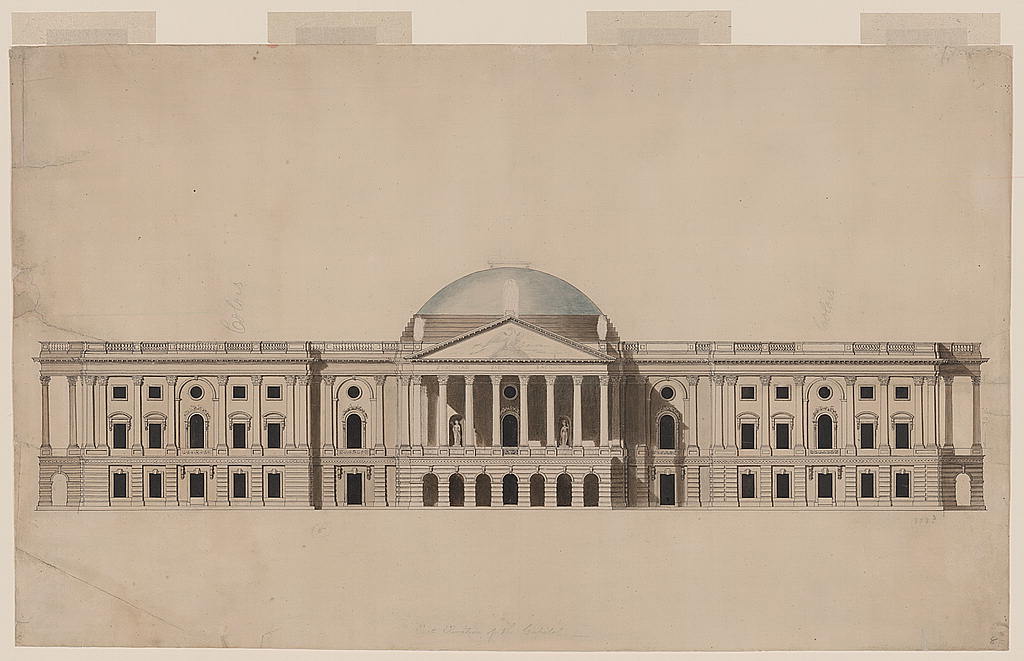
| "A. Z." (Thomas Jefferson) | Secretary of State (Anonymous) | Palladian style, inspired by Villa Rotonda. Domed roof. | Rejected. Jefferson lost to his own subordinate's process. |
| James Diamond | Maryland Builder | Rectangular court, ornate detailing, "vaguely absurd" roof elements. | Rejected. Deemed too complex and stylistically incoherent. |
| Jacob Small | Builder | Maze-like interior hallways, disconnected wings. | Rejected. Functionally impractical for a residence. |
| Philip Hart | Amateur | Faux-Renaissance style, foreshortened top floor, awkward proportions. | Rejected. absence necessary architectural sophistication. |
James Hoban won the competition, his victory came with immediate executive interference. Washington reviewed Hoban's winning elevation and demanded changes. The President felt the design was too small for the of the presidency. He ordered the building expanded from nine bays to eleven bays across the facade and insisted on a more generous, although the height was reduced from three stories to two to manage costs. The final dimensions settled at approximately 168 feet in length and 85 feet in width. Hoban's design drew heavily from Leinster House in Dublin, the current seat of the Irish Parliament, reflecting his training in the Dublin Society of Arts.
Construction began immediately, with the laid on October 13, 1792. The material selection process revealed the logistical limitations of the new capital. The commissioners selected Aquia Creek sandstone from a quarry in Stafford County, Virginia, approximately 40 miles downstream. This stone was readily available and easy to carve, it possessed a serious flaw: it was porous and soft. Upon exposure to the elements, the stone hardened also degraded rapidly if not protected. This geological reality necessitated the application of a lime-based whitewash to seal the stone, a practice that eventually gave the building its nickname, though the moniker "White House" did not become official until Theodore Roosevelt's administration in 1901.
The labor force that built the Executive Mansion exposes the economic reliance on chattel slavery in the early republic. The commissioners hired enslaved African Americans from local slaveholders, paying the owners for the labor. These enslaved workers toiled alongside free African Americans and white laborers, including Scottish stonemasons recruited specifically for their skill in cutting the intricate sandstone details. The payroll records from 1794 to 1797 list the names of enslaved laborers, such as Ben, Daniel, and Peter, who dug the foundations and moved the massive stone blocks. The use of enslaved labor was a calculated cost-saving measure by the commissioners, who were constantly battling budget deficits.
Financial mismanagement and supply chain failures plagued the project. The initial cost estimate of $200, 000 proved optimistic. By the time President John Adams moved into the unfinished residence on November 1, 1800, the total cost had climbed to $232, 372. Even then, the building was a shell. The East Room was unplastered, the main staircase was missing, and the roof leaked. Adams famously used the East Room to hang laundry, a clear contrast to the "Palace" L'Enfant had imagined. The heating system was insufficient for the cavernous rooms, and the absence of a functioning bell system made communicating with servants difficult.
By 2026, the preservation of the original 1792-1800 structure remains a complex engineering challenge. The Aquia Creek sandstone, over two centuries old, requires constant monitoring. The of paint applied over 225 years have created a thick shell, beneath it, the original stone remains susceptible to moisture intrusion and freeze-thaw pattern. Modern preservationists use ground-penetrating radar and other non-invasive metrics to assess the integrity of the masonry without stripping the protective coating. The survival of Hoban's walls is less a testament to the durability of the materials and more a result of continuous, expensive intervention. The metrics of the 1792 competition, budget, size, and speed, resulted in a building that was physically compromised from the start, requiring a permanent maintenance regime to prevent the soft Virginia sandstone from returning to the earth.
Enslaved Labor and Masonry Construction 1792-1800

The construction of the President's House relied on a labor system defined by the rental of human beings. While the Commissioners of the District of Columbia initially planned to import workers from Europe to meet their needs, recruitment efforts across the Atlantic failed to produce sufficient numbers. Consequently, the federal government turned to the local slave economy of Maryland and Virginia. Between 1792 and 1800, the workforce consisted of a fluctuating mix of white wage laborers, skilled European artisans, and enslaved African Americans. The government did not own these workers; instead, they hired them from local slaveholders, paying the wages directly to the masters while providing the enslaved men with basic rations, housing in temporary huts, and medical care.
The raw material for the residence came from Aquia Creek in Stafford County, Virginia, approximately forty miles downstream from the capital. In December 1791, the federal government purchased the quarry on Brent's Island (later Government Island) from the Brent family for £1, 800 (roughly $6, 000). The conditions at the quarry were brutal. Workers contended with intense heat, mosquitoes, and poisonous snakes while extracting the heavy sandstone. To maintain productivity in these harsh conditions, the commissioners authorized a daily ration of one half-pint of whiskey for the laborers. The stone, a porous variety of freestone, was cut and hauled onto rafts, then poled up the Potomac River to the construction site.
Payroll records preserved in the National Archives expose the economics of this arrangement. A 1795 "Carpenter's Roll" lists four enslaved men, Tom, Peter, Ben, and Harry, owned by James Hoban, the architect of the White House himself. Hoban collected their wages. While skilled white stone cutters could earn up to $1. 34 per day and unskilled laborers around $0. 31, the rates for enslaved workers varied based on their skill level, yet the money never reached their pockets. A promissory note from 1795 records a payment to Jasper M. Jackson for the hire of "Negro Dick" at a rate of five dollars per month. The payrolls frequently marked these entries with the letter "N" or the label "Negro hire" to distinguish them from free laborers.
Specific individuals appear in the historical record, though frequently stripped of their full identities. Beyond Hoban's carpenters, records from August 1795 list enslaved sawyers named Simon, Jerry, Jef, Charles, Len, Dick, Bill, and Jim. These men performed the backbreaking work of sawing lumber and hauling stone. enslaved workers, like Peter, possessed skilled carpentry abilities and earned wages for their masters comparable to those of white apprentices. The reliance on this workforce was not a temporary stopgap a foundational element of the project. Historian Bob Arnebeck estimates that over 200 enslaved individuals labored on the White House and Capitol during this period, working alongside free blacks and immigrants from Scotland and Ireland.
The ceremonial beginning of the construction occurred on October 13, 1792. A procession formed at Suter's Tavern in Georgetown, consisting of the District commissioners, town council members, and Freemasons from Lodge No. 9. They marched to the site where the was laid in the southwest corner of the foundation. Pedro Casanave, the Master of the lodge, presided over the Masonic ritual, which included the placement of a brass plate and the consecration of the stone with corn, wine, and oil. No President attended; George Washington was in Philadelphia at the time. The ceremony projected an image of high republican ideals, standing in sharp contrast to the reality of the coerced labor that dug the trenches and laid the stone.
Technical challenges plagued the masonry work from the start. The Aquia sandstone, while easy to carve, was soft and porous, making it susceptible to water damage and cracking during winter freezes. To protect the exterior, Scottish stonemasons applied a lime-based whitewash in 1798. This sealant, rather than a stylistic choice, gave the building the distinctive white appearance that eventually led to its popular name. The walls were constructed as a double: an inner wall of brick and an outer facing of stone, designed to provide structural stability and insulation.
Conflict arose among the leadership as the project dragged on. Collen Williamson, a master mason from Scotland appointed to superintend the stone work, clashed repeatedly with James Hoban and the commissioners. Williamson prioritized the quality and technical precision of the stone setting, while the commissioners, under pressure to show progress, demanded speed. The dispute escalated until the commissioners fired Williamson in 1795. His dismissal removed a check on the construction pace, yet funding absence continued to slow the work. By 1796, the commissioners were forced to suspend work on the Capitol to focus remaining resources on completing the President's House in time for the government's arrival in 1800.
When President John Adams arrived on November 1, 1800, the residence remained unfinished. Only six rooms were habitable. The main staircase was not installed, the roof leaked, and the plaster was still wet. Abigail Adams famously used the unfinished East Room to hang her laundry, as it was the only space large and dry enough for the task. The grounds were cluttered with debris, kilns, and the temporary shacks that had housed the workers. The mansion stood in a raw, open field, with no fencing to keep out the public or wandering livestock.
Modern research in the 2020s has begun to correct the historical narrative regarding the builders of the White House. For nearly two centuries, the role of enslaved labor was obscured or minimized in official accounts. Initiatives like the "Slavery in the President's Neighborhood" research project by the White House Historical Association have systematically analyzed payrolls and letters to identify the enslaved men by name. In 2012, a commemorative marker was placed at the Government Island quarry to acknowledge the masons and enslaved laborers who extracted the stone. These efforts show that the symbol of the American presidency was physically constructed by those denied the very freedom the office was sworn to protect.
British Arson and 1817 Reconstruction Expenditures
| Category | Detail |
|---|---|
| Total Appropriation | Part of $500, 000 federal loan for DC public buildings |
| Estimated Specific Cost | ~$246, 490 (Final accounting varied by source) |
| Architect Salary | James Hoban: ~$1, 500 per year |
| Primary Materials | Aquia Creek sandstone, timber, lead, glass |
| Construction Duration | 1815 to 1817 (approx. 3 years) |
| Structural Change | Substitution of timber for interior brick partitions |
The reconstruction effort required a massive logistical operation to transport materials to the site. The exterior stone, scorched and blackened by soot, presented an aesthetic problem. While workers cleaned the masonry, the scars remained visible. To conceal the damage and protect the porous sandstone from the elements, Hoban ordered the entire building painted with a thick coat of white lead-based paint. Although the term "White House" had been used informally prior to the war, this post-fire treatment solidified the name in the American lexicon, transforming a need of repair into an enduring symbol. President James Monroe moved into the reconstructed residence in late 1817, though the building was far from complete. The East Room remained unfinished, serving as a storage area, and the furnishings were a mix of surviving pieces and new purchases from France, funded by a $20, 000 congressional appropriation that Monroe quickly exhausted. The haste to reoccupy the mansion led to the use of wet plaster and unseasoned wood, causing minor structural settling that plagued the house for decades. The 1817 reconstruction established a pattern of "patch-and-fix" maintenance that defined the White House's physical history until the mid-20th century. Hoban's reliance on timber framing to save time created a fire trap and a weak skeleton, hidden behind the stately stone facade. When engineers examined the building in 1948, they found that the 1817 timber beams had been sawed through to accommodate gas pipes and electrical wiring over the years, leaving the second floor held up largely by "force of habit." The scorch marks from the 1814 fire were rediscovered during that 1948 gutting, hidden behind plaster and paint for 134 years, physical evidence of the British arson that nearly erased the capital. The burning of the White House remains the singular instance of total devastation to the seat of the executive branch. The subsequent reconstruction was less a triumph of architectural innovation than a victory of political. By forcing the government to invest in rebuilding the charred shell, Madison and his allies anchored the federal district in place, ending the wandering nature of the American capital. The white paint applied in 1817 did more than cover soot; it sealed the Compromise of 1790, ensuring that the banks of the Potomac would remain the center of American power, even if that power resided within a structure compromised by the very shortcuts taken to save it.
Sanitary Infrastructure and Plumbing Overhauls 1830-1902
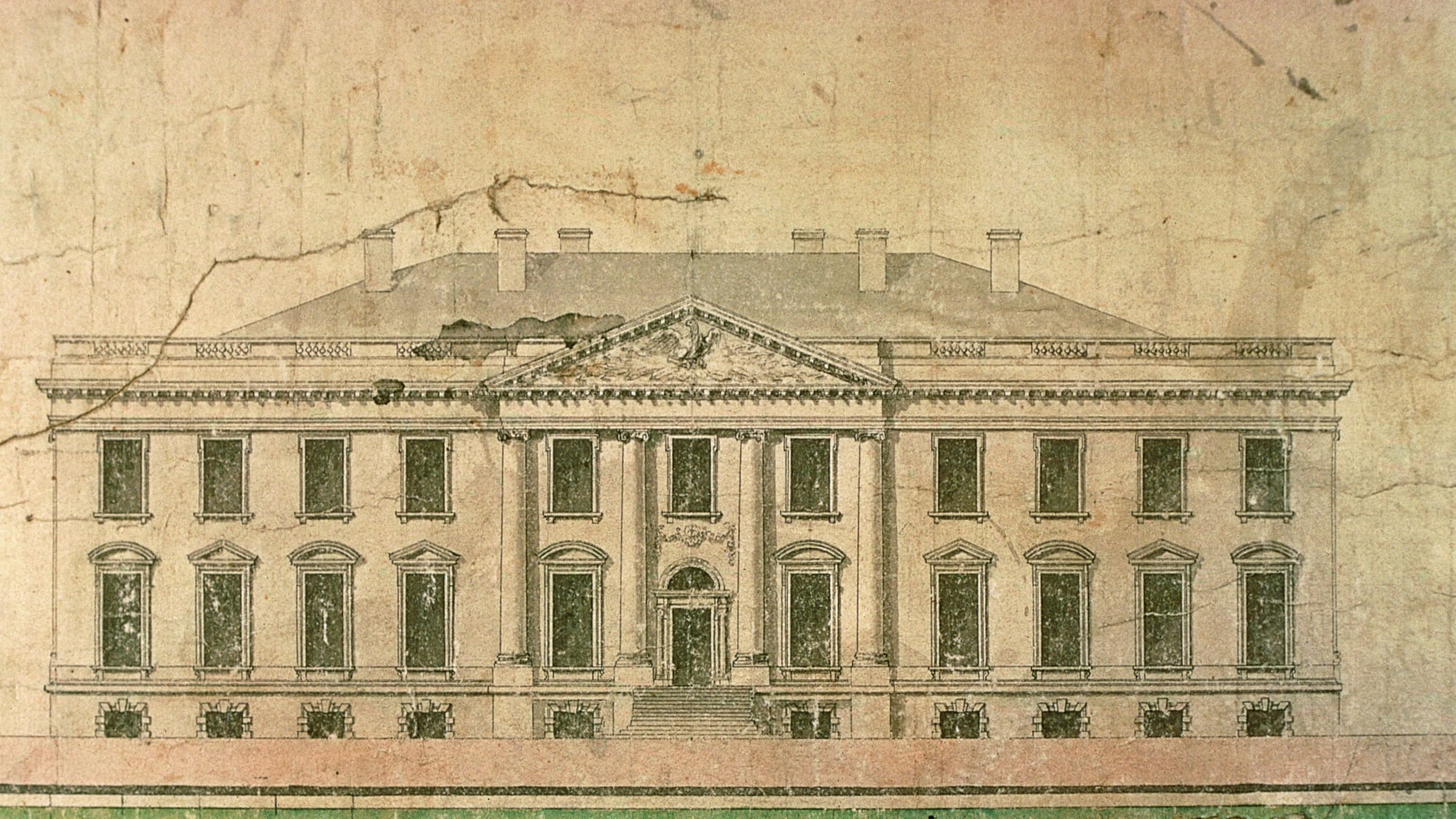
Table: Sanitary Milestones and Failures 1833-1902
| Year | Event/Upgrade | Impact on Health/Infrastructure |
| 1833 | Iron pipes installed (Jackson) | Provided fire protection and bathing room; water source was Franklin Park spring. |
| 1853 | Second floor bathroom (Pierce) | hot/cold running water upstairs; introduced risk of sewer gas leaks. |
| 1862 | Death of Willie Lincoln | Typhoid fever attributed to contaminated Potomac water supplied to the house. |
| 1881 | Garfield Assassination Aftermath | Doctors blamed "bad plumbing" for the President's septic decline (later disproven, sparked inspection). |
| 1890s | Harrison/Cleveland Era | Rats reported in the basement; water deemed "poisonous" by staff. |
| 1902 | McKim, Mead & White Renovation | Complete removal of 19th-century plumbing; installation of modern porcelain and drainage. |
The Civil War exposed the lethal nature of this infrastructure. By 1861, the population of Washington had exploded with soldiers and bureaucrats. The Potomac River, the source for the city's water, became heavily contaminated with the runoff from army camps, including human waste and animal carcasses. In February 1862, Abraham Lincoln's beloved son, Willie, fell ill. His symptoms, fever, dehydration, and delirium, pointed to typhoid fever. Modern epidemiologists and historians agree that the water Willie drank and bathed in was the vector. The boy died on February 20, 1862. His death was a direct result of the failure to separate the capital's water supply from its sewage. Following the war, the "sewer gas" panic of the 1870s and 1880s turned public attention toward the White House plumbing. The germ theory of disease was gaining traction, yet the older belief in "miasmas" (bad air). Both theories pointed to the rotting smells of the White House as a source of death. When President James A. Garfield was shot in 1881, he lingered for months in the White House. During his decline, engineers rigged a primitive air conditioning system involving fans and ice. Critics later argued that the air intake was positioned too close to a sewer vent, pumping "poisonous" air into the sickroom. While dirty medical instruments caused Garfield's fatal sepsis, the state of the plumbing was so poor that incoming President Chester A. Arthur refused to move in until a thorough cleaning and inspection occurred. He famously described the house as "a badly kept barracks." By the 1890s, the residence was physically rotting. President Benjamin Harrison and his family lived in fear of the house. The basement was infested with rats, and the dampness in the walls was pervasive. The plumbing was a patchwork of lead and iron pipes, of which leaked into the floorboards. The "water closets" were frequently foul-smelling, and the family frequently fled the house for the cleaner air of their own homes or resorts. The structure itself was failing; the addition of pipes and wires over the decades had cut through load-bearing beams, leaving the second floor dangerously unstable. The breaking point arrived in 1902. President Theodore Roosevelt, inheriting the mansion after McKinley's assassination, found it uninhabitable for his large family. He hired the architectural firm McKim, Mead & White to execute a brutal and total renovation. The architects reported that the house was "insanitary" and "unsafe." Their investigation revealed that the ground beneath the basement was honeycombed with old cesspools and rotting drains that had never been properly decommissioned. The 1902 renovation was not a mere remodel; it was an excavation. Workers stripped the interior down to the brick shell. They removed the rotting timber and the labyrinth of lead pipes. The old "troughs" used for drainage were replaced with modern ceramic pipes. The architects installed new bathrooms with white porcelain fixtures, designed to be easily cleaned and to show dirt, a visual shift toward the "sanitary aesthetic" of the Progressive Era. They connected the White House to the newly modernized city sewer system, severing the link between the President's bathtub and the cesspools of the past. This overhaul marked the end of the White House's primitive era. The installation of modern plumbing required structural steel supports to hold the weight of the new bathrooms, fundamentally changing the engineering of the house. The "stench" that had plagued the Adams, Lincoln, and Garfield administrations was exorcised. By 2026 standards, the 1902 plumbing was simple, yet it established the baseline for the complex hydraulic systems that serve the residence. The transition from the bucket brigades of 1830 to the porcelain of 1902 mirrors the nation's own painful journey toward public health and industrial maturity.
The 1902 Roosevelt Expansion and West Wing Fabrication
By 1902, the Executive Mansion was no longer a functional seat of government; it was a firetrap. President Theodore Roosevelt, having assumed office after William McKinley's assassination, found himself living in a "crazy quilt" of Victorian alterations, with his large family of six children squeezed into the second floor alongside the entire executive staff. The situation was untenable. Clerks worked in the hallways, and the President's office was a bedroom. Roosevelt demanded an immediate separation of the private residence from the public business of the presidency. He turned to the preeminent architectural firm of the Gilded Age, McKim, Mead & White, with a mandate to execute a total renovation in a punishingly short window: less than six months.
The renovation, which began in June 1902, was as much a demolition as a restoration. Charles McKim, the lead architect, viewed the accumulated Victorian decor of the late 19th century, the heavy velvets, the gaslight fixtures, and the ornate glasswork, as a corruption of the building's original Federal purity. His team moved with ruthless efficiency. The most significant casualty was the complex of glass conservatories on the west grounds. These greenhouses, a beloved feature of the Victorian White House, were razed to the ground to make way for a new, "temporary" structure dedicated to the executive staff. This structure, built for a modest $65, 000, was the genesis of the modern West Wing. It was connected to the main house by a colonnaded gallery, a design choice that re-established the Jeffersonian terraces long buried under soil and debris.
Inside the residence, McKim's team stripped the interior to its brick shell. The most controversial removal was the opalescent glass screen commissioned by President Chester Arthur and designed by Louis Comfort Tiffany. This massive, multi-colored partition, which had separated the entrance hall from the cross hall, was regarded by Roosevelt as a symbol of decadent excess. Reports from the time suggest Roosevelt wanted it "smashed," though it was sold at auction for a pittance. In its place, McKim installed a screen of simple columns, returning the entrance to a clear, neoclassical aesthetic that McKim argued was true to James Hoban's original vision, even if the historical accuracy of this "restoration" was largely an invention of the Beaux-Arts style.
The structural changes were far more consequential than the aesthetic ones. To expand the State Dining Room, McKim ordered the removal of the grand staircase at the west end of the Cross Hall. This decision necessitated the removal of a serious load-bearing wall. To support the upper floors, engineers inserted a steel truss into the attic and hung the second floor from the roof structure. This engineering solution, a "nip and tuck" fix intended to save time and money, introduced a fatal structural flaw. The steel truss was insufficient for the load, and the removal of the supporting masonry wall transferred immense stress to the internal timber frame. While the renovation succeeded in creating a "State" floor of expanded grandeur, capable of seating 140 guests under game heads and tapestries, it quietly compromised the building's skeletal integrity, a ticking clock that would not stop until the near-collapse of 1948.
The financial scope of the project was immense for the era. Congress appropriated approximately $475, 445 for the renovation, a figure that covered the construction of the temporary office, the structural modifications, and the complete redecoration of the state rooms. The East Room was transformed from a carpeted Victorian parlor into a gleaming hall of white and gold, featuring low-relief panels by the Piccirilli Brothers. The plumbing and electrical systems were modernized, replacing the erratic gaslights with electric chandeliers and installing modern bathrooms. Yet, even with this expenditure, the 1902 renovation was a cosmetic triumph built on a fractured foundation. The "temporary" West Wing became permanent, and the structural shortcuts taken to meet Roosevelt's deadline ensured that the White House would remain a fragile shell, its internal decay masked by fresh plaster and white paint for another half-century.
The 1948 Truman Gutting and Steel Frame Installation
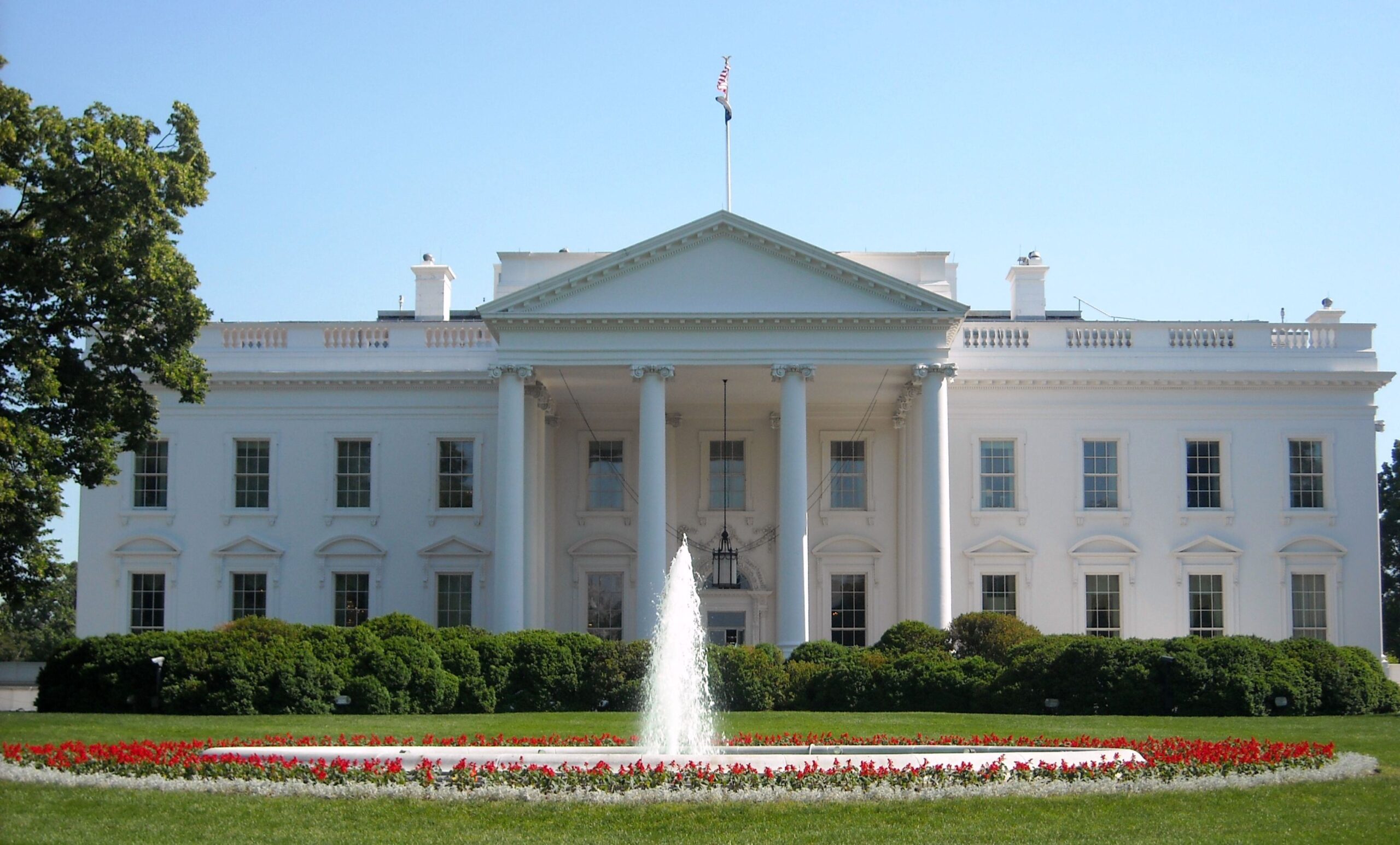
By 1948, the White House was a death trap. After 150 years of piecemeal renovations, the timber-framed mansion was structurally exhausted. The British burning of 1814 had weakened the original masonry, and subsequent administrations had ruthlessly cut into load-bearing beams to install gas pipes, electrical wiring, and plumbing. The breaking point arrived in June 1948, when the leg of Margaret Truman's baby grand piano slipped through a rotting floorboard in her second-floor sitting room. While the piano did not crash through to the State Floor, the incident dislodged plaster in the Family Dining Room, signaling a catastrophic failure of the building's integrity.
The physical symptoms of the building's decay were impossible to ignore. During a formal reception in the Blue Room, Lady Bess Truman watched with alarm as the massive crystal chandelier above her head swayed in rhythm with the guests the floor above. President Harry S. Truman reported his bathtub sinking into the floorboards, joking grimly that he might soon plunge naked into a tea party of the Daughters of the American Revolution. A confidential investigation by W. E. Reynolds, Commissioner of Public Buildings, delivered a clear verdict in January 1948: the second floor was in "imminent danger of collapse." Reynolds famously noted that the mansion was standing "by force of habit only."
Faced with the option to demolish the structure entirely or preserve its historic exterior, Congress and Truman chose a radical third route: a complete gutting of the interior while leaving the outer sandstone walls standing. This decision initiated the most invasive construction project in the site's history since the 1814 fire. The Family evacuated to the nearby Blair House in late 1948, where they would reside for over three years. The renovation, led by architect Lorenzo Winslow and contractor John McShain, required the removal of every internal wall, floor, and support beam. The White House was reduced to a hollow shell, a void of 165 feet by 85 feet, open from the basement to the roof.
To prevent the exterior walls from collapsing inward during demolition, engineers erected a complex web of steel scaffolding. Small bulldozers were dismantled, carried inside piece by piece, and reassembled to clear the debris. The of the material removal was immense. Workers stripped away the lath and plaster, exposing the char marks from the War of 1812 on the original stone. While Winslow attempted to salvage historic trim and mantels, much of the interior woodwork was deemed too damaged to save. The contractor, McShain, famously allowed of the discarded timber and stone to be sold as souvenirs or landfilled, a practice that would be unthinkable in modern preservation standards.
The primary objective of the 1948-1952 renovation was the installation of a load-bearing steel frame. The mansion ceased to be a timber-framed house and became, structurally, a steel skyscraper encased in stone. Workers installed 660 tons of steel beams and columns, creating a rigid internal grid that supported concrete floor slabs. This new skeleton rendered the building fireproof and capable of supporting the weight of modern mechanical systems. The renovation also excavated two new sub-basement levels to house air conditioning plants, storage, and a secret bomb shelter, known as "Project 9," funded by a classified $881, 000 allocation separate from the public budget.
| Feature | 1814 Reconstruction | 1952 Truman Renovation |
|---|---|---|
| Load Bearing System | Timber beams & brick partitions | Steel H-beams & reinforced concrete |
| Foundation Depth | Shallow spread footings | Deep concrete piers (20+ feet) |
| Fire Resistance | Zero (wood lath, timber floors) | High (steel, concrete, fire doors) |
| Sub-levels | None (Ground floor on grade) | Two deep sub-basements |
| Cost (Nominal) | ~$360, 000 (approx.) | $5. 7 Million |
The project was plagued by cost overruns and labor strikes. Originally estimated at $5. 4 million, the final price tag rose to $5. 7 million (approximately $66 million in 2026 currency). The "Truman Balcony," a second-floor porch added to the South Portico in 1948 just before the gutting, remained a point of contention. Critics argued it disrupted the vertical lines of the portico, yet it was the only structural element of the "old" house that engineers deemed safe enough to keep intact during the demolition. The steel installation permanently altered the acoustics and feel of the residence; the creaking wooden floors were replaced by solid, unyielding concrete covered in parquet or carpet.
When the Trumans returned in March 1952, the White House was a modern facility disguised as a historic home. The Grand Staircase was reoriented to open into the Entrance Hall for dramatic effect, a change from the Cross Hall orientation of 1902. Central air conditioning was fully integrated, hidden behind cornices and in the new utility chases. The steel frame ensured the building would never again face the threat of structural collapse, yet it also locked the floor plan into a rigid configuration, making future architectural changes significantly more difficult and expensive.
Nuclear Bunkers and Subterranean Excavations 1942-2026
| Era | Project Name / Cover | Location | Primary Function |
|---|---|---|---|
| 1941-1942 | East Wing Construction | East Wing (Sub-basement) | Original PEOC (FDR Bomb Shelter) |
| 1941 | Treasury Tunnel | East Wing to Treasury Bldg | Emergency Evacuation Route |
| 1987 | Project ZP (Rumored) | Oval Office to PEOC | Rapid Egress Tunnel |
| 2010-2012 | West Wing Infrastructure Improvement | North Lawn / West Wing | Deep Underground Command Center (DUCC) |
| 2025-2026 | State Ballroom Project | East Wing (Demolition/Rebuild) | PEOC Replacement & EMP Hardening |
Security for these subterranean zones are absolute. Access requires biometric verification including retinal scans and weight sensors. The air pressure inside the bunker complex is maintained at a higher level than the outside atmosphere. This positive pressure ensures that in the event of a leak, air flows out rather than allowing chemical or biological agents to flow in. The 2026 upgrades also reportedly include a closed-loop life support system capable of recycling oxygen and water for months, severing the facility's dependence on the surface world entirely. The evolution of the White House underground reflects the darkening horizon of global threats. What began as a simple concrete basement to hide from Luftwaffe bombs has metastasized into a multi-level subterranean city. The manicured lawns of the Executive Mansion are the roof of a designed to survive the end of the world. As construction crews in 2026 pour fresh concrete into the crater where the East Wing once stood, they are not just building a ballroom. They are entombing the continuity of government in steel and stone.
Security Perimeter Hardening and Airspace Restrictions
The transformation of the White House from an accessible "People's House" into a fortified citadel represents a physical timeline of American threat perception. In the early 19th century, the security perimeter was almost nonexistent by modern standards. Thomas Jefferson replaced a simple post-and-rail barrier with a wooden split-rail fence in 1801, primarily to keep livestock out rather than to keep citizens at bay. Public access remained a core tenet of the presidency for decades. In 1829, thousands of well-wishers surged into the mansion for Andrew Jackson's inauguration, damaging furniture and forcing the new president to flee through a window. This openness even after the British Army burned the structure in 1814, a catastrophic perimeter failure that left the capital in ruins.
The shift toward exclusion began in earnest during World War II. Following the attack on Pearl Harbor in 1941, the Secret Service established sentry boxes at the gates, ending the era where citizens could simply walk onto the grounds. The assassination attempt on President Harry S. Truman in 1950, which occurred at the nearby Blair House while the White House underwent renovation, further hardened the protective philosophy. Two Puerto Rican nationalists, Griselio Torresola and Oscar Collazo, engaged in a gun battle with police officers at the front door, resulting in the death of Officer Leslie Coffelt. This event proved that the threat could manifest at the very threshold of the executive residence.
Aerial threats emerged as a distinct vulnerability in the late 20th century, forcing a reevaluation of the airspace above the complex. On February 17, 1974, U. S. Army Private Robert K. Preston stole a Bell UH-1B Iroquois helicopter from Fort Meade, Maryland. He flew the aircraft to Washington, D. C., hovering near the Lincoln Memorial before landing directly on the South Lawn. Secret Service agents opened fire with shotguns, wounding Preston and forcing his surrender. The incident demonstrated that a low-flying aircraft could bypass traditional ground defenses with ease. It exposed a gap in the protective net that ground-based fences could not address.
Twenty years later, that aerial vulnerability was exploited again with lethal results. On September 12, 1994, Frank Eugene Corder, a truck driver with a history of substance abuse, stole a Cessna 150L from a Maryland airport. In the early morning hours, he piloted the single-engine plane into the restricted airspace of the capital. Corder crashed the aircraft onto the South Lawn, skidding across the grass and slamming into the wall of the mansion the presidential bedroom. He died on impact. The crash clipped a magnolia tree planted by Andrew Jackson and cracked a window of the White House. Although President Bill Clinton was staying at Blair House at the time, the event shattered the illusion that the perimeter ended at the fence line.
The most significant alteration to the physical footprint of the complex occurred in 1995, driven by the threat of vehicle-borne improvised explosive devices (VBIEDs). Following the Oklahoma City bombing on April 19, 1995, which destroyed the Alfred P. Murrah Federal Building, the Secret Service concluded that a truck bomb on Pennsylvania Avenue could devastate the White House. On May 20, 1995, President Clinton ordered the closure of Pennsylvania Avenue to vehicular traffic between 15th and 17th Streets. This decision, initially controversial among city planners and merchants, permanently altered the urban grid of Washington, D. C. The avenue, once a bustling thoroughfare, became a pedestrian plaza, pushing the blast zone back by several hundred feet.
The attacks of September 11, 2001, codified the airspace restrictions that encase the capital. The Federal Aviation Administration (FAA) established Prohibited Area 56 (P-56), a highly restricted zone of airspace surrounding the White House and the U. S. Capitol. P-56A covers the immediate area of the National Mall and the executive mansion, extending from the surface up to 18, 000 feet. Pilots who violate this airspace face immediate interception by military aircraft, license revocation, and chance criminal charges. This "no-fly" zone is enforced by a sophisticated array of radar systems and ground-based air defense units, creating an invisible dome over the seat of government.
Ground security faced a serious test on September 19, 2014, when Omar Gonzalez, an Army veteran carrying a folding knife, scaled the north fence. In a shocking lapse of protocol, Gonzalez sprinted 200 feet across the lawn, bypassed a guard dog team that was not deployed, and entered the unlocked North Portico doors. He overpowered an officer inside and penetrated as far as the East Room before being tackled. This intrusion, the deepest in modern history, triggered a cascade of investigations and resignations within the Secret Service. It proved that the existing six-foot fence, installed in the 1960s, was functionally obsolete against a determined athletic intruder.
In response to the Gonzalez incident and other fence-jumping attempts, the National Park Service and Secret Service launched a massive perimeter hardening project in 2019. With a budget of approximately $64 million, the project replaced the historic fence with a formidable barrier designed to meet modern threat specifications. The new fence, completed in 2021, stands roughly 13 feet tall, double the height of its predecessor. It features wider, stronger steel pickets and incorporates "anti-climb" technology, including a specialized top guard that prevents an intruder from gaining a handhold. The foundation of the fence was deepened to prevent tunneling, and the structure includes integrated intrusion detection sensors that alert the Joint Operations Center the moment pressure is applied.
The civil unrest of 2020 further accelerated the fortification of the complex. During protests in Lafayette Square following the death of George Floyd, federal authorities erected temporary non- fencing that extended the perimeter outward to H Street, turning the area into a militarized zone. While the temporary blocks were eventually removed, the event solidified a "bunker" mentality in security planning. The subsequent installation of the permanent 13-foot fence signaled an acceptance that the White House must function as a and a museum second.
By 2026, the security apparatus protecting the White House has evolved into a multi-domain defense system. The perimeter is no longer defined solely by the iron fence by a network of surveillance and interdiction capabilities. This includes advanced drone detection and jamming systems designed to neutralize unmanned aerial systems (UAS) before they can breach the grounds. In 2015, a small quadcopter crashed on the lawn, highlighting the drone threat; today, radio-frequency countermeasures are active 24/7 to sever the link between a pilot and their device. The Secret Service budget for FY 2025 requested $3. 2 billion, a figure that reflects the immense cost of maintaining this zero-fail mission. The modern White House exists inside an "Iron Cage" of sensors, steel, and armed personnel, a clear contrast to the open grounds where Jefferson once walked.
| Date | Incident / Event | Security Consequence |
|---|---|---|
| Feb 17, 1974 | Helicopter landing (Robert Preston) | Exposed low-altitude aerial vulnerability; led to revised air defense. |
| Sep 12, 1994 | Cessna crash (Frank Eugene Corder) | Confirmed the risk of suicide aircraft attacks; heightened radar monitoring. |
| May 20, 1995 | Pennsylvania Ave Closure | Eliminated vehicular traffic north of the White House to mitigate truck bomb threats. |
| Sep 19, 2014 | North Portico Intrusion (Omar Gonzalez) | Intruder reached East Room; triggered the $64 million fence replacement project. |
| 2019, 2021 | Fence Replacement Project | Fence height increased to ~13 feet; anti-climb and intrusion detection tech added. |
Operating Budget and Maintenance Costs 2000-2026
Table: Major White House Physical Plant Expenditures (Adjusted & Nominal)
| Project / Item | Time Period | Nominal Cost (At Time) | Funding Source |
|---|---|---|---|
| Truman Reconstruction | 1948, 1952 | $5. 7 Million | Federal Appropriation |
| Executive Residence Budget | FY 2000 | $9. 2 Million | Annual Appropriation |
| East & West Wing Renovation | 2008 | $561 Million (Est) | Federal (GSA/EOP) |
| Executive Residence Budget | FY 2020 | $13. 1 Million | Annual Appropriation |
| Perimeter Fence Replacement | 2019, 2021 | $64 Million | Secret Service / NPS |
| Executive Residence Request | FY 2026 | $16. 1 Million | Annual Appropriation |
| East Wing Ballroom Project | 2025, 2026 | $200, $400 Million (Est) | Private / Mixed |
The "Repair and Restoration" account frequently fails to cover the true depth of deferred maintenance. The GSA reported in 2024 that deferred maintenance across its entire federal portfolio had ballooned, and the White House is not immune to these aging systems. The HVAC systems in the West Wing, pushed to capacity by the heat generated from modern server racks and 24-hour operations, require constant monitoring. In 2017, the West Wing was vacated for weeks to overhaul the cooling system, a maintenance need that forced staff to work from the EEOB. These operational disruptions highlight the tension between maintaining a 200-year-old museum and operating a modern command center. Staffing costs within the Executive Residence budget remain the most consistent line item. This workforce is non-political; butlers, maids, and engineers serve for decades, spanning multiple administrations. Their salaries are capped by the appropriation, and overtime is strictly monitored. Unlike the policy staff in the West Wing, whose salaries fall under the "White House Office" budget (a separate $50M+ entity), the residence staff are paid solely to maintain the dignity and function of the home. The separation of these funds prevents political appointees from draining the resources needed to keep the building standing. As of 2026, the financial outlook for the White House suggests a continued reliance on hybrid funding models for major expansions, as seen with the ballroom project, while the taxpayer-funded operating budget tracks closely with inflation. The GSA continues to warn that the aging infrastructure of the complex requires sustained investment, specifically regarding the underground service that support the mansion's power and data needs. The cost of maintaining the symbol of the presidency is high, the cost of its failure, structural or operational, would be far higher.
Energy Consumption Data and Solar Array Installations

The energy profile of the White House serves as a longitudinal study in American resource consumption, shifting from the raw caloric burn of Virginia timber to the kilowatt-hungry demands of a modern secure command center. For over two centuries, the Executive Residence has operated as a paradoxical facility: a museum required to function as a 24-hour office, frequently trapping its occupants in a battle against the humid subtropical climate of the Potomac basin. Historical data reveals that the building's energy appetite has grown exponentially, driven not by the addition of square footage, by the density of technology and the expectation of climate control.
Early heating methods relied entirely on open masonry fireplaces, a system that proved woefully inefficient for a mansion with high ceilings and drafty corridors. Records from the 19th century indicate that the sheer volume of wood required to keep the residence habitable during winter was immense, later supplemented by coal. The introduction of central heating arrived in 1840, when a hot-air system was installed to warm the transverse hallways and state rooms. Yet, the private quarters remained dependent on individual fires until the Polk administration expanded the ductwork in 1845. The transition to electricity began in 1891 under Benjamin Harrison, a modernization with such apprehension that the President and Lady frequently refused to touch the switches, fearing electrocution, and left the lights burning overnight until staff intervened.
Cooling the residence proved a far more formidable engineering challenge than heating it. The "swamp" myth of Washington D. C. is geographically inaccurate, yet the city's humidity is a documented meteorological fact. In 1909, President William Howard Taft authorized an experimental cooling system for the West Wing. Engineers installed large bins in the attic capable of holding thousands of pounds of ice. Electric fans forced air over the melting ice and down through the heating ducts. The system failed completely; the air barely cooled before reaching the rooms, and the humidity remained stifling. Taft eventually abandoned the effort, preferring to sleep on a screened porch constructed on the roof. It was not until the reconstruction of the West Wing in 1929, following a Christmas Eve fire, that the Carrier Engineering Company installed the central air conditioning system. The residence itself did not receive reliable climate control until the Truman renovation (1948, 1952), which integrated modern HVAC ducting into the new steel superstructure.
The history of solar power at the White House offers a clear timeline of American energy politics, functioning less as a facility management decision and more as a signal of executive priority. The installation and removal of photovoltaic and thermal arrays track closely with the oscillating energy philosophies of the last five decades.
| Administration | Year | System Type | Capacity / | Status / Outcome |
|---|---|---|---|---|
| Jimmy Carter | 1979 | Solar Thermal (Water Heating) | 32 Panels (InterTechnology/Solar Corp) | Removed in 1986 during roof resurfacing. |
| Ronald Reagan | 1986 | None (Removal) | N/A | Panels dismantled; later acquired by Unity College, Maine. |
| George W. Bush | 2002 | Photovoltaic (PV) & Thermal | 9 kW (Grid-tied) + 2 Thermal Units | Installed quietly on the maintenance building and pool cabana. |
| Barack Obama | 2013 | Photovoltaic (PV) | 6. 3 kW Array | Installed on the Executive Residence roof; operational. |
| Joe Biden | 2020-2024 | Efficiency Upgrades | N/A (System Integration) | Focus on heat pumps and weatherization. |
Jimmy Carter's 1979 installation of 32 solar thermal panels on the West Wing roof cost approximately $28, 000. These units were designed to heat water for the staff mess, providing roughly 75 percent of the kitchen's hot water needs. During the dedication, Carter famously declared the solar heater could be "a curiosity, a museum piece, an example of a road not taken," or a valid energy source. In 1986, the Reagan administration removed the array. Official statements roof maintenance requirements, yet the panels were never reinstalled, a decision widely interpreted as a rejection of the previous administration's conservationist ethos.
A frequently overlooked chapter in this history occurred in 2002 under George W. Bush. While the administration favored traditional fossil fuel industries, the National Park Service oversaw the installation of a 9-kilowatt photovoltaic system and two solar thermal systems. Unlike the Carter and Obama arrays, these were placed on the grounds maintenance building and the pool cabana, keeping them out of public view. This system powered the groundskeeping operations and heated the swimming pool, functioning as a practical facilities upgrade rather than a public policy statement.
In 2010, Energy Secretary Steven Chu announced the return of solar to the residence roof, fulfilling a pledge by the Obama administration. The installation, completed in 2013, featured a 6. 3-kilowatt array of American-made panels. While the system generated only a fraction of the complex's total electricity demand, estimated at the time to cost nearly $200, 000 annually, it reintegrated renewable generation into the visible infrastructure of the White House.
The energy narrative shifted again in the mid-2020s. Following the 2024 election, the executive branch initiated a reversal of federal sustainability mandates. By February 2026, the administration had rolled back Biden-era requirements for electric vehicle procurement and clean energy tax credits. Data from the Energy Information Administration (EIA) released in late 2025 indicated that U. S. electricity bills had risen by approximately 11 percent over the preceding year. The current administration, operating under a "Drill Baby Drill" agenda, prioritized the expansion of liquefied natural gas (LNG) exports, which hit a record 100 million metric tons in 2025. Consequently, the White House energy strategy in 2026 reflects a return to conventional baseload power reliance, diverging from the net-zero set earlier in the decade.
Modern energy audits of the White House Complex are classified for security reasons, yet estimates based on similar federal structures suggest the facility consumes energy at an intensity far higher than a standard commercial building. The 55, 000-square-foot residence contains 132 rooms and 35 bathrooms, all requiring climate stabilization to protect historic artifacts and artwork. The integration of sensitive server rooms, secure communications equipment (SCIFs), and perimeter lighting creates a relentless electrical load. Even with the 2013 solar array and the 2002 maintenance building system, the White House remains overwhelmingly dependent on the commercial grid. The complex stands as a testament to the difficulty of retrofitting historic masonry for efficiency; the thick sandstone walls of 1792 possess high thermal mass offer poor insulation against the temperature extremes of the capital.
As of February 2026, the White House operates within a national context of rising utility costs and a fractured energy policy. While the solar panels from 2013 remain on the roof, the broader federal apparatus has pivoted toward maximizing fossil fuel production. The residence, much like the country, relies on a hybrid infrastructure where 19th-century masonry meets 21st-century power demands, resulting in a facility that is operationally yet energetically expensive.
Executive Residence Staffing and Domestic Logistics
The following table details the operational hierarchy and estimated staffing levels of the Executive Residence as of 2026.
| Department | Role | Primary Function | Est. Staff Count |
|---|---|---|---|
| Usher's Office | Chief Usher | General Manager / CEO of Residence | 1 |
| Usher's Office | Assistant Ushers | Shift management and logistics | 4 |
| Culinary | Executive Chef | Head of kitchen operations | 1 |
| Culinary | Executive Pastry Chef | Desserts and baked goods | 1 |
| Culinary | Sous Chefs / Cooks | Food preparation | 5-7 |
| Housekeeping | Executive Housekeeper | Cleaning and room preparation | 1 |
| Housekeeping | Maids / Housemen | Daily cleaning and heavy lifting | 15-20 |
| Maintenance | Carpenters / Engineers | Physical plant repair | 8-12 |
| Maintenance | Electricians / Plumbers | Systems maintenance | 6-8 |
| Service | Butlers | Food service and valets | 6-10 |
| Specialty | Chief Floral Designer | Flower arrangements | 4-6 |
| Specialty | Chief Calligrapher | Invitations and place cards | 3 |
| Curatorial | Curator | Art and furniture preservation | 4 |
The Office of the Curator maintains the White House collection of fine art and furniture. This office tracks over 65, 000 objects. The Curator works with the Committee for the Preservation of the White House to approve any changes to the state rooms. The Family has more latitude to alter the private quarters on the second and third floors. Yet even these changes frequently require consultation to ensure historical integrity is not compromised. The Curator also manages the rotation of artwork. Presidents select pieces from the permanent collection or borrow works from the Smithsonian and National Gallery of Art to decorate the Oval Office and residence. Security clearances for residence staff are among the most in the government. These employees have close physical proximity to the President and the Family. They witness private conversations and family. The background check process, known as a "Yankee White" clearance, involves a deep investigation into the individual's loyalty, character, and reliability. This vetting process applies to everyone from the Chief Usher to the temporary wait staff hired for large events. The budget for the Executive Residence is distinct from the budget for the White House Office. The $15. 6 million appropriation covers salaries for the residence staff, utilities, and maintenance. It does not cover the salaries of the political staff in the West Wing. The separation of funds prevents the use of taxpayer money for the President's personal expenses. The distinction is strict. If a butler serves a meal at a political fundraiser held in the residence, the political party must reimburse the government for the butler's time. Domestic logistics extend to the care of the 18 acres of grounds. The National Park Service maintains the lawns and gardens, the residence staff coordinates the schedule. The Chief Horticulturist oversees the Rose Garden and the Kitchen Garden. The produce from the Kitchen Garden, established in 2009, continues to supply the White House kitchen and local food banks. The grounds crew must coordinate their work with the Secret Service to ensure that lawn mowers and maintenance vehicles do not interfere with presidential movements or helicopter landings. The staffing model of the Executive Residence relies on discretion. Staff members sign non-disclosure agreements. They are trained to be invisible. They enter rooms only when necessary and leave immediately upon completing their tasks. This culture of silence protects the privacy of the Family. It also preserves the dignity of the office. The few staff members who have broken this code and written tell-all books frequently face ostracization from the tight-knit community of former White House employees. The residence staff views their loyalty to the institution as superior to their loyalty to any single President. This professional ethos has allowed the same butlers and maids to serve Presidents with vastly different political ideologies without friction.
Digital Infrastructure and Cyberdefense Systems 2026
By 2026, the primary defense perimeter of the White House is no longer the wrought-iron fence along Pennsylvania Avenue, a digital dragnet patrolling the Executive Office of the President (EOP) network. Following the "Salt Typhoon" cyberespionage campaign, which U. S. intelligence confirmed in late 2024 had compromised the wiretap systems of major telecommunications providers, the White House accelerated its migration to a "Zero Trust" architecture. This security model, mandated by Executive Order 14028, operates on the assumption that no user or device, even those inside the physical building, can be trusted by default. By the close of Fiscal Year 2026, federal agencies, including the EOP, faced a binding deadline to achieve specific maturity levels in identity verification and data encryption, ending the era of perimeter-based network security.
The nerve center for this digital defense is the renovated White House Situation Room, a 5, 500-square-foot intelligence complex located in the West Wing basement. Completed in September 2023 at a cost of $50 million, the overhaul required excavating five feet into the earth to install fiber-optic cables capable of handling classified data streams at speeds previously unattainable. The complex, run by the National Security Council, includes the "JFK Conference Room," where the President convenes with top advisors. The renovation removed the legacy server floors and installed a "Watch Floor" that operates 24/7, monitoring global crises. To prevent digital eavesdropping, the facility is a Sensitive Compartmented Information Facility (SCIF) constructed with electromagnetic shielding. Visitors, including Cabinet secretaries, must surrender all personal electronics into glass lockers before entry, a protocol strictly enforced to prevent "zero-click" spyware infections.
The White House communications infrastructure is divided into distinct, air-gapped networks to mitigate risk. The Non-Classified Internet Protocol Router Network (NIPRNet) handles routine administrative traffic and is the most frequent target for external probes. The Secret Internet Protocol Router Network (SIPRNet) and the Joint Worldwide Intelligence Communications System (JWICS) carry classified and top-secret data, respectively. This segmentation from hard-learned lessons; in 2014, Russian hackers breached the unclassified EOP network, reading the President's non-public schedule for months. The intrusion forced a total network shutdown and a shift in strategy from "prevention" to "assume breach," where defenders actively hunt for intruders already inside the wires.
The evolution of White House connectivity mirrors the history of American telecommunications. In the 1860s, President Abraham Lincoln walked to the War Department telegraph office to receive updates on the Civil War, as no direct line existed in the Executive Mansion. President Rutherford B. Hayes installed the telephone in 1877, though the technology was initially viewed as a novelty with few practical applications. By 1992, the digital age arrived when President George H. W. Bush became the commander-in-chief to use email. The subsequent explosion of digital records created a new legal hazard: the Presidential Records Act. The sheer volume of data, millions of emails generated annually, led to archiving controversies during the Clinton and George W. Bush administrations, where millions of messages were initially lost or mislabeled due to server misconfigurations.
In 2026, the White House Communications Agency (WHCA) manages a "traveling bubble" that ensures the President remains connected to the National Command Authority anywhere on Earth. This capability relies on "The Beast," the presidential limousine, which functions as a mobile SCIF with its own encrypted satellite uplink. When airborne, Air Force One provides a similar hardened communications suite. The WHCA, a joint-service military unit, operates on a budget that prioritizes redundancy. If commercial cellular networks fail, or are compromised by actors like Salt Typhoon, the President's communications shift to military-grade frequency hopping and satellite constellations that bypass civilian infrastructure entirely.
A central focus of the 2026 cybersecurity agenda is the migration to Post-Quantum Cryptography (PQC). National Security Memorandum 10 (NSM-10) identified the chance for quantum computers to break current public-key encryption standards, a threat known as "Q-Day." While a cryptographically relevant quantum computer may not yet exist, intelligence agencies warn of "harvest, decrypt later" tactics, where adversaries steal encrypted data today to unlock it once the technology matures. Consequently, the White House began a rigorous inventory of all cryptographic assets in 2025, with 2026 marking the start of mandatory upgrades to quantum-resistant algorithms for all National Security Systems.
The following table outlines the progression of major communication milestones and security upgrades at the White House:
| Era / Year | Technology / Event | Operational Impact |
|---|---|---|
| 1860s | Telegraph (War Dept) | Lincoln monitors Civil War troop movements via off-site office. |
| 1877 | Telephone Installed | President Hayes adopts voice comms; initially limited utility. |
| 1963 | The "Hotline" (MOLINK) | Direct teletype link to Kremlin established after Cuban Missile emergency. |
| 1992 | Presidential Email | George H. W. Bush sends digital message; start of digital archiving. |
| 2014 | "Cozy Bear" Breach | Russian hackers compromise unclassified EOP network; forces security overhaul. |
| 2023 | Sit Room Renovation | $50M gut renovation; installation of advanced fiber and anti-surveillance tech. |
| 2024 | Salt Typhoon Incident | Chinese breach of US telecom wiretaps exposes vulnerability of external "pipes." |
| 2026 | Zero Trust Deadline | Mandatory implementation of identity-based security architecture (EO 14028). |
The threat environment in 2026 demands that the White House operate not just as a seat of government, as a hardened data center. The integration of Artificial Intelligence into threat detection systems allows the EOP to analyze network traffic patterns in real-time, identifying anomalies that human analysts might miss. Yet, the human element remains the weak link. Strict govern the use of personal devices by staff, and "phishing-resistant" multi-factor authentication is universal. As the Executive Branch prepares for the quantum era, the digital walls of the White House are constantly being rebuilt, invisible to the tourists outside essential to the continuity of the American government.